
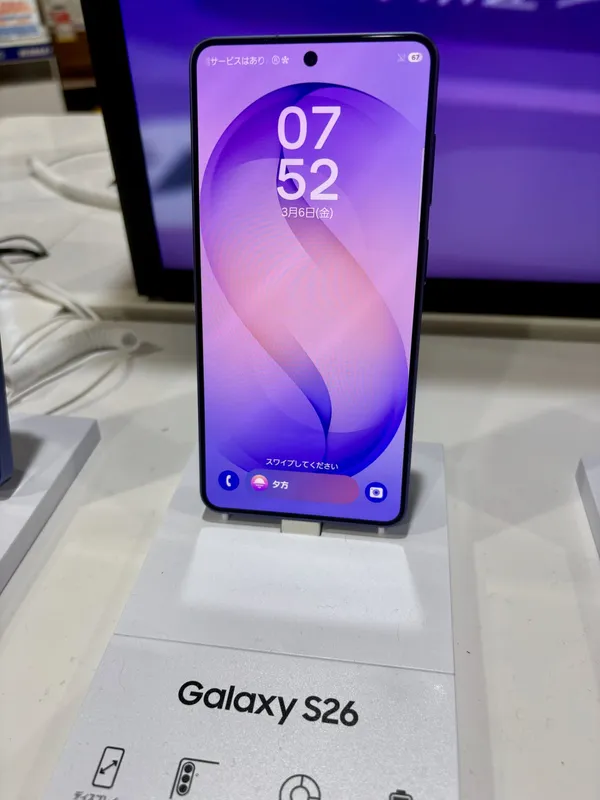

The Galaxy S26 is the smallest of Samsung’s three main S26 phones and the one most people compare with the standard iPhone. This page lays out what Samsung documents for its cable, charger and screen, and where it differs from the Galaxy S26 Ultra. Every figure is traced to a source listed at the bottom of the page.
Key specs
| Release date | 2026-03-11 |
|---|---|
| Status | Current lineup |
| Charging port | USB-C |
| Wired charging (max, W) | 25 |
| Wireless charging | Qi |
| Charger in box | No |
| Display type | OLED |
| Display size (in) | 6.3 |
| Refresh rate (Hz) | 120 |
| Chip | Snapdragon 8 Elite Gen 5 for Galaxy |
| Storage options | 256GB, 512GB |
| Launch price (USD, MSRP) | $899.99 |
The USB spec row is empty because we found no Samsung statement of a USB version for the US model. Wireless charging shows Qi because Samsung lists WPC compatibility and does not mention Qi2.
Where does the Galaxy S26 fit?
Samsung’s US announcement said the Galaxy S26, S26+ and S26 Ultra were available to pre-order that day, with general availability from March 11, 2026. The Galaxy S26 started at $899.99 with 256GB and 512GB of storage, against $1,099.99 for the S26+ and $1,299.99 for the S26 Ultra. Shared colors across the series are Cobalt Violet, White, Black and Sky Blue, with Pink Gold and Silver Shadow sold on Samsung.com.
Reporting on Counterpoint Research’s Q2 2026 data puts it ninth among the world’s best-selling smartphones, behind the S26 Ultra at fourth, which is why it ranks eighth in our library. It is on Samsung’s current US lineup page. The Samsung hub lists the rest of the family.
What cable does the Galaxy S26 use?
Samsung’s US support page lists a USB Type-C 3A charging cable in the box, so the phone charges over USB Type-C. See our USB-C explainer for the connector. Samsung’s table for the S26 says its 25W figure uses a 25W adapter and a 3A USB-C cable, which is a lower rating than the 5A cables the USB-IF mentions for older 100W Power Delivery setups; see USB Power Delivery.
We do not state a data speed because Samsung’s pages did not give a USB version for this model; the USB speed guide explains the general tiers. For tips on buying a replacement, read cable buying safety.
What charger does the Galaxy S26 need?
Wired. Samsung lists Super Fast Charging up to 25W with up to 55% charge in around 30 minutes using a 25W adapter and a 3A USB-C cable. Samsung says its wired charging is compatible with QC2.0 and AFC PD. The box does not include an adapter, so you buy or reuse one. Samsung’s 25W power adapter page describes Super Fast Charging as a method based on USB Power Delivery 3.0 and lists PPS support at up to 25W; see PPS and Samsung Super Fast Charging and the wattage guide.
Wireless. Samsung lists Fast Wireless Charging up to 15W, compatible with WPC, and Wireless PowerShare, which lets the phone charge another compatible device. Samsung’s US accessories page lists Magnet cases that support fast wireless charging up to 25W with magnetic accessories, but Samsung’s table gives the phone itself 15W. See Qi explained and the wireless charger guide.
For a short checklist, read which charger is safe for my phone. Samsung’s guidance is to use Samsung-approved chargers and cables.
The screen, explained
The Galaxy S26 has a 6.3-inch FHD+ Dynamic AMOLED 2X display with a 120Hz adaptive refresh rate that runs from 1 to 120Hz, and 2600 nits peak brightness. Samsung says the 6.3-inch figure is measured on the full rectangle and the screen is 6.1 inches with the rounded corners accounted for.
The S26 Ultra’s headline Privacy Display is not listed for this model in the pages we checked. Samsung describes AMOLED as a type of OLED screen technology, which we cover in OLED explained; the refresh rate guide explains the 1 to 120Hz range. Samsung does not use the term LTPO for this phone, so we label it plain OLED; see LTPO OLED.
Performance, cameras and battery
The phone has the Snapdragon 8 Elite Gen 5 for Galaxy, with 12GB of RAM. The battery is 4,300 mAh, a typical value tested under third-party laboratory conditions.
The cameras are a 50MP wide, a 12MP ultra wide and a 10MP 3x telephoto, with 3x optical zoom, 2x optical-quality zoom and 30x digital zoom. The selfie camera is 12MP. Video goes up to 8K at 30fps or 4K at 60fps.
Build, connectivity and durability
Samsung lists IP68 water resistance based on submersion in up to 1.5 meters of freshwater for up to 30 minutes, with the usual note that the protection is not permanent. The phone measures 71.7 x 149.6 x 7.2 mm and weighs 167 grams. It supports 5G (sub-6), Wi-Fi 7 and Bluetooth 5.4, and runs Android 16 with One UI 8.5. Samsung says the Galaxy S26 series is supported with seven generations of OS upgrades and seven years of security updates.
What is in the box
Samsung’s US support page lists the phone, a USB Type-C 3A charging cable and a SIM ejector tool. There is no power adapter. Samsung’s own table says the figures it lists need its adapter, so the speed you get depends on the adapter you add.
How it compares with the S25 Ultra and the S26 Ultra
Samsung’s tables let you place this phone between two others. Against the Galaxy S26 Ultra, the Galaxy S26 has a 6.3-inch display against 6.9 inches, a 4,300 mAh battery against 5,000 mAh, 25W wired charging against 60W and 15W wireless against 25W, and it lacks the S Pen and Privacy Display. It does share the Snapdragon 8 Elite Gen 5 for Galaxy chip, the 1 to 120Hz Dynamic AMOLED 2X panel and the seven-year update promise.
Against last year’s Galaxy S25 Ultra, the S26 is far smaller and lighter at 167 grams against 218 grams. On paper the S25 Ultra charges faster, because Samsung’s table for it cites a 45W adapter and up to 65% in around 30 minutes, while the S26 table cites a 25W adapter and up to 55% in the same time. The S25 Ultra also has the larger 5,000 mAh battery and a built-in S Pen. For many buyers the practical question is size and weight, where Samsung’s figures put the S26 well ahead.
Charging tips from Samsung
Samsung’s support page on fast charging says Super Fast Charging is only available on select devices and needs a 25W or 45W Samsung-approved adapter, that your device automatically chooses the best speed it supports, and that plugging the adapter into a wall outlet charges faster than plugging the cable into a computer. It also advises using only Samsung-approved chargers and cables. Those points apply here: the S26 is built around a 25W adapter and a 3A USB-C cable, so a 25W adapter is the match, and our charger buying guide explains the standards to look for.
Repair overview
iFixit has a device page for the Samsung Galaxy S26. When we checked it listed no repairability score and no repair guides, so we show none and link only to the device page. We never copy iFixit’s text.
Read our repair overview for the Galaxy S26, battery replacement basics, screen replacement basics and how to read repairability scores. Our battery page cites Apple’s guidance because we have not yet found a Samsung equivalent.
Video reviews
We have not verified individual review videos for this phone, so we do not list any. You can browse more video reviews of the Galaxy S26 on YouTube.
Compatible accessories
Samsung lists silicone, slim, rugged and clear Magnet cases, anti-reflecting screen films and 60W and 45W adapters for the S26 family; a 25W adapter matches this phone’s rating. We do not have affiliate links yet; when we do they will be marked as paid links.
See the accessories hub, chargers and power banks, which have airline rules.
Who should buy it, and who might skip it
Facts that help you decide:
- You want a smaller flagship. It is 6.3 inches and 167 grams, against 6.9 inches and 214 grams for the Galaxy S26 Ultra.
- You want long software support. Samsung lists seven generations of OS upgrades and seven years of security updates.
- You want fast wired charging. Samsung’s 25W figure is lower than the 60W on the S26 Ultra.
- You want a charger included. None is in the box; budget for a 25W adapter.
- You want Privacy Display or an S Pen. Those are listed for the S26 Ultra, not this phone.