
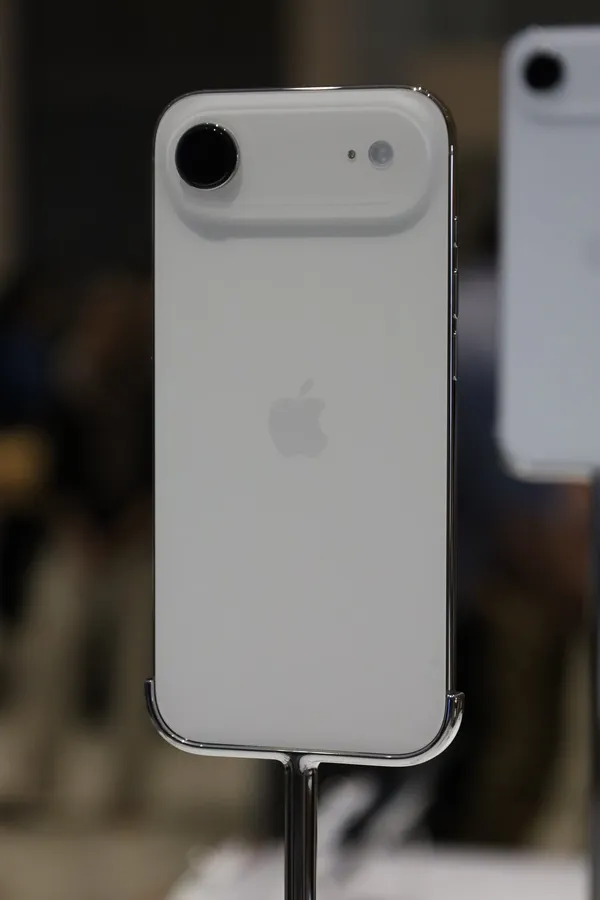

The iPhone Air trades some of the extras on other iPhones for thinness, and that makes its published specifications worth reading closely before you buy accessories. This page gathers Apple’s documents and iFixit’s repair information, and compares the Air with the iPhone 17. Every figure is traced to a source listed at the bottom of the page.
Key specs
| Release date | 2025-09-19 |
|---|---|
| Status | Current lineup |
| Charging port | USB-C |
| USB spec | USB 2 (up to 480Mb/s) |
| Wireless charging | Qi2, MagSafe |
| Charger in box | No |
| Display type | OLED |
| Display size (in) | 6.5 |
| Refresh rate (Hz) | 120 |
| Chip | A19 Pro |
| Storage options | 256GB, 512GB, 1TB |
| Launch price (USD, MSRP) | $999 |
| iFixit repairability score | 7/10 |
The wired charging row is blank on purpose: Apple publishes a fast-charge claim tied to an adapter, not a maximum wattage.
Where does the iPhone Air fit?
Apple introduced the iPhone Air alongside the iPhone 17 family. Its announcement says pre-orders began Friday, September 12, 2025, with availability beginning Friday, September 19, and a launch-day post confirms the new iPhones reached Apple Stores that day. It started at $999 in the US with 256GB, 512GB and 1TB of storage. Apple lists four finishes: space black, cloud white, light gold and sky blue.
We could not find the iPhone Air in the sales rankings we cite, so it sits seventeenth in our library as part of Apple’s current lineup. Apple’s main iPhone lineup page lists it alongside the iPhone 18 Pro, iPhone 17, iPhone 17e and iPhone 16. See the Apple hub for the rest of the range.
What cable does the iPhone Air use?
The iPhone Air has one USB-C connector. Apple’s specifications list charging and USB 2 data transfer at up to 480Mb/s. Note what is missing from that list compared with the Pro models: Apple lists DisplayPort support for the iPhone 17 and the Pro models, but the Air’s charging and expansion entry lists only charging and USB 2. The Pro models list USB 3 at up to 10Gb/s, which the Air does not.
Because the USB-IF says USB products run at the lowest common speed, a faster cable will not speed up the Air’s data transfers. See the USB speed guide, the USB-C explainer and cable buying safety. The box includes a 1 m USB-C charge cable that Apple says supports fast charging and works with USB-C power adapters and computer ports.
What charger does the iPhone Air need?
Wired. Apple lists the iPhone Air as fast-charge capable: up to 50% charge in 30 minutes with a 20W adapter or higher paired with a USB-C charging cable, or with a 30W adapter or higher and a MagSafe Charger, both sold separately. The iPhone Air does not include a power adapter. See the wattage guide and USB Power Delivery.
MagSafe and Qi2. Apple lists MagSafe wireless charging up to 20W and Qi2 wireless charging up to 20W. Apple’s MagSafe page says the iPhone Air achieves 20W peak power, against 25W on the iPhone 17 and 17 Pro families, and notes that charging is limited to 16W while USB-C or Lightning accessories are connected. See Qi2 explained and the wireless charger guide.
A battery accessory. Apple’s specifications list up to 27 hours of video playback and up to 40 hours with the iPhone Air MagSafe Battery, an accessory that attaches to the back. Apple does not give the battery’s cost or capacity in the pages we checked, so we say only that it exists. For a short checklist on adapters, read which charger is safe for my phone.
The screen, explained
The iPhone Air has a 6.5-inch all-screen OLED display, branded Super Retina XDR, at 2736-by-1260 pixels and 460 ppi, with Dynamic Island, an Always-On display and ProMotion with adaptive refresh rates up to 120Hz. Apple lists 1000 nits typical maximum brightness, 1600 nits peak for HDR and 3000 nits peak outdoors. OLED means each pixel makes its own light; see OLED explained and the refresh rate guide. Apple does not use the term LTPO on the pages we checked; see LTPO OLED.
Performance, cameras and battery
The A19 Pro chip has a 6-core CPU (2 performance and 4 efficiency cores), a 5-core GPU with Neural Accelerators and a 16-core Neural Engine, according to Apple. Apple’s announcement says the Air has the most Apple-designed chips in an iPhone, including the A19 Pro, the N1 wireless chip and the C1X cellular modem, and calls it the most power-efficient iPhone ever made.
The rear camera is a single 48MP Fusion system with a 26 mm main lens at f/1.6 and sensor-shift optical image stabilization, which also enables a 12MP optical-quality 2x telephoto at 52 mm. The front camera is an 18MP Center Stage camera. Apple lists up to 27 hours of video playback and up to 22 hours of streamed video.
Build and durability
Apple says the iPhone Air has a grade 5 titanium frame, and lists a titanium design with a Ceramic Shield 2 front and a Ceramic Shield back. It is rated IP68, with a maximum depth of 6 meters for up to 30 minutes under IEC standard 60529. It measures 6.15 inches tall, 2.94 inches wide and 0.22 inch (5.64 mm) deep and weighs 165 grams. It supports Wi-Fi 7, Bluetooth 6 and Thread, and 5G on sub-6 GHz bands with 4x4 MIMO; mmWave 5G is not listed.
How it compares with the iPhone 17
Apple’s specification pages show the trade-offs. The Air has a larger 6.5-inch display than the iPhone 17’s 6.3 inches and a 165-gram body against 177 grams, uses the A19 Pro rather than the A19, and has a titanium frame where the iPhone 17 has aluminum. It lists a single rear camera where the iPhone 17 lists two 48MP rear cameras, and it lists no mmWave 5G or DisplayPort support. On wireless charging the Air tops out at 20W against 25W. The Air launched at $999 against $799 for the iPhone 17.
What is in the box
Apple’s specifications list the iPhone Air, a 1 m USB-C charge cable and documentation, and say the iPhone Air does not include a power adapter or EarPods. Apple encourages you to use any compatible USB-C power adapter.
Getting the most from MagSafe
Apple’s MagSafe guidance applies to the iPhone Air. Apple says the system adapts to conditions and that the power actually delivered depends on the iPhone model, the wattage of the power adapter and system conditions, so 20W is a peak, not a constant. It stresses plugging the charger into power before placing the phone on it, so MagSafe can verify it is safe to deliver maximum power; if you placed the phone on the charger first, remove it, wait three seconds and put it back. Apple says the iPhone Air achieves 20W peak power, below the 25W of the larger models, and lists the 25W-class chargers by part number A3502, A3503, A2580 or A3250. Check the part number on the charger or its cable.
Repair overview
iFixit’s device page for the iPhone Air shows a repairability score of 7 out of 10. iFixit lists guides including battery removal, screen removal and back glass removal. We link to them and never copy iFixit’s text. iFixit’s score page for the Air says the design prioritizes screen repairs while giving access to other parts through the back glass, that an electrically releasing adhesive streamlines battery replacements, and that repair parts and instructions are available from Apple, while flagging four different screwhead types and continued reliance on adhesives.
Read our repair overview for the iPhone Air, battery replacement basics, screen replacement basics and how to read repairability scores.
Video reviews
We have not verified individual review videos for this phone, so we do not list any. You can browse more video reviews of the iPhone Air on YouTube.
Compatible accessories
Apple’s announcement mentions an iPhone Air Case with MagSafe in frost and shadow, an iPhone Air Bumper in four colors and a Crossbody Strap. Categories to look at: MagSafe cases, 20W chargers and screen protectors. We do not have affiliate links yet; when we do they will be marked as paid links.
See the accessories hub, chargers and power banks, which have airline rules.
Who should buy it, and who might skip it
Facts that help you decide:
- You want the thinnest iPhone. Apple lists 5.64 mm and 165 grams.
- You want repair information. iFixit scores it 7 out of 10.
- You want fast wired data. Apple lists USB 2 only, against USB 3 on the Pro models.
- You want mmWave 5G. Apple does not list it for the Air.
- You want a charger included. None is in the box; budget for a 20W or higher adapter.
- You want the lowest price. It launched at $999, against $799 for the iPhone 17.